04: Moving Innovation Into Practice and Carrying It Forward
Savannah and Augusta, Georgia
From research to real-world use
Lamarr.AI grew out of research led in part by Georgia Tech professor and company co-founder, Tarek Rakha, PhD, whose work focused on retrofit design for buildings in underserved communities. PIN supported that early work several years ago through a Community Research grant. As the research developed into a company, the relationship evolved with it.
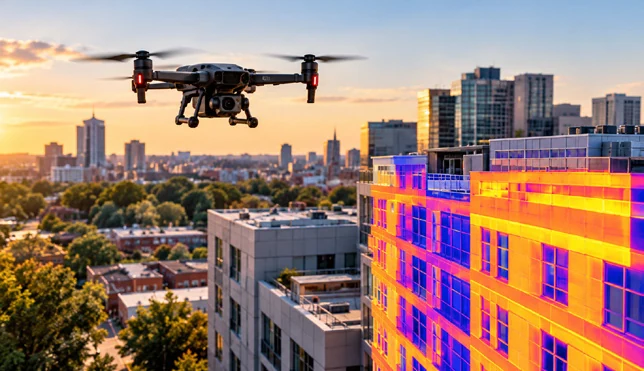
Lamarr.AI uses drones, infrared imaging, and artificial intelligence to identify building-envelope problems and retrofit opportunities, which Dr. Rakha describes as “giving a building an MRI.”
PIN later invested in the company and helped open doors to public-sector applications. Together, that investment and community access gave Lamarr.AI more opportunities to test its technology in real settings. Dr. Rakha said those connections changed how the company thought about where its technology could be useful:
“Partnership for Innovation opened our eyes to opportunities to work with the government, and PIN began opening doors through its relationships and network. That helped us see how our technology could be useful in new ways and create opportunities to work with cities and neighborhoods.”—Dr. Tarek Rakha
In Savannah, Lamarr.AI assessed four municipal facilities. After reviewing the findings, the city asked the company to take Fire Station Headquarters from an initial assessment to a deeper audit with energy modeling, repair priorities, and ROI context. The work projected 5.95% whole-building energy savings from identified improvements and up to 11.45% when paired with window upgrades.
As the deployments expanded to Augusta, Lamarr.AI added staff and generated additional revenue. Across both communities, 16 buildings were assessed or scanned.
PIN also enabled Lamarr.AI to host two summer interns, Jose Chavez and Prachi, who contributed to market research, pricing, go-to-market strategy, automation, and customer development.
The work demonstrates how community deployment can help promising technologies build the evidence, relationships, and momentum needed to scale.
Reducing energy waste and improving capital planning
Through deployments in Savannah and Augusta, Lamarr.AI helped public-sector facilities identify building performance issues that are often difficult to detect through traditional inspections. Community partners received building-specific analysis that helped prioritize maintenance investments, evaluate retrofit opportunities, and improve energy performance.
Source: PIN 2026 Impact Report, pages 16–17 and 19.
Find your place
Explore Community Investment.
Use this story as a starting point, then explore the relevant pathway.